

CorePoise CorePoise Men's supplement guide · Jakarta
A man resting quietly at the edge of a bed in early morning light, a small supplement jar on the side table

CorePoise · Jakarta

Questions about the prostate usually arrive later, not earlier

A man may be forty-five and lifting heavy, with a shelf of stamina products at home, and still not have looked at what the aisle keeps for men twenty years older. That second shelf exists. It holds different nutrients, calmer wording, and a smaller local range than anything built around energy and training. This page walks through what is commonly discussed for prostate and age-related men's wellness in Indonesia, how those products are positioned, and where the sensible boundary sits between shelf reading and a conversation with a doctor.

Chapter one

Why prostate topics appear later

Two shelves, one aisle, different audiences. The quiet one is not less serious. It simply waits until the reader has a reason to look.

The shelf-skew effect

Most men's supplement shelving is built for younger shoppers: stamina, vitality, gym recovery, everyday energy. Prostate products sit in a quieter corner of the same aisle, often behind or beside the general multivitamins, and they are aimed at men in their fifties and older — or at men whose doctor has raised the subject during a routine visit. The audience arrived with a question, so the shelf does not need to shout.

The tone shifts with it

That change in audience rewrites the copy. You will see fewer performance words and more about urinary comfort, normal function, and supporting the body as it ages. Indonesian regulation limits how far that wording can go, which is part of why the language on these labels reads flat and careful. Calm wording is a compliance habit, not a quality signal.

Read the panel, not the aisle

Older men and younger men are sold different blends, so age is a rough guide at best. A man in his late forties can read a prostate-positioned product; an eighty-year-old may not need one at all if his multivitamin already covers the minerals. The ingredient panel answers the question the shelf only hints at.

Where the boundary sits

Supplements are not treatments, and this page is not a diagnosis. If you have symptoms or a diagnosed condition, that belongs with a doctor in Indonesia, not with a shopping basket.

Contact the editorial team

What commonly appears on the panel

Four entries older men's formulas keep returning to

Below are the ingredients most often discussed when a product is positioned for prostate or age-related men's wellness. None of this describes an outcome; it describes what is on the label and why the entry is worth reading carefully before you buy.

Saw palmetto

The berry extract people look for first

Saw palmetto is the ingredient most often attached to prostate-positioned products worldwide, usually listed as a berry extract with the standardized percentage shown in brackets. Plant sterols frequently appear in the same formulas, sometimes spelled out as beta-sitosterol. Both are botanical entries rather than vitamins, which is why they tend to appear in blends aimed at older men instead of training products.

In Indonesian listings these show up far less often than the stamina herbs, so the local category is thin and you may end up comparing imported products instead. If a product mentions prostate on the front of the box, the practical check is whether saw palmetto is actually on the panel and at what extract strength — front-of-pack wording and the ingredient list do not always agree.

Zinc and selenium

Two minerals doing quiet work across categories

Zinc and selenium appear across men's categories, and prostate positioning is only one of the places they turn up. The same pair also shows in fertility formulas such as Nutrimax Male Formula Rx, which is a useful reminder that nutrients get reused across audiences with different front-of-pack stories.

Reference intake values exist for both minerals, so these are among the easier label entries to evaluate against what you already take. The practical risk is duplication rather than shortage: if you already use a multivitamin, check the combined zinc and selenium totals before adding a second targeted product on top.

Vitamin E

An oil-soluble entry with a format clue

Vitamin E is an oil-soluble vitamin, which is why it is more likely to arrive in a softgel than in a pressed tablet. It appears in blends aimed at older men and in general men's products as well, so seeing it on a panel tells you less about the product's positioning than zinc or saw palmetto would.

Beyond vitamin E, many prostate-positioned products simply carry a standard multivitamin base with a few added botanicals. That is worth understanding before you pay a premium: on a lot of these labels the base does most of the work, and the extras are extras. The format rule still holds — oil-soluble vitamins in a softgel, minerals in a capsule or tablet.

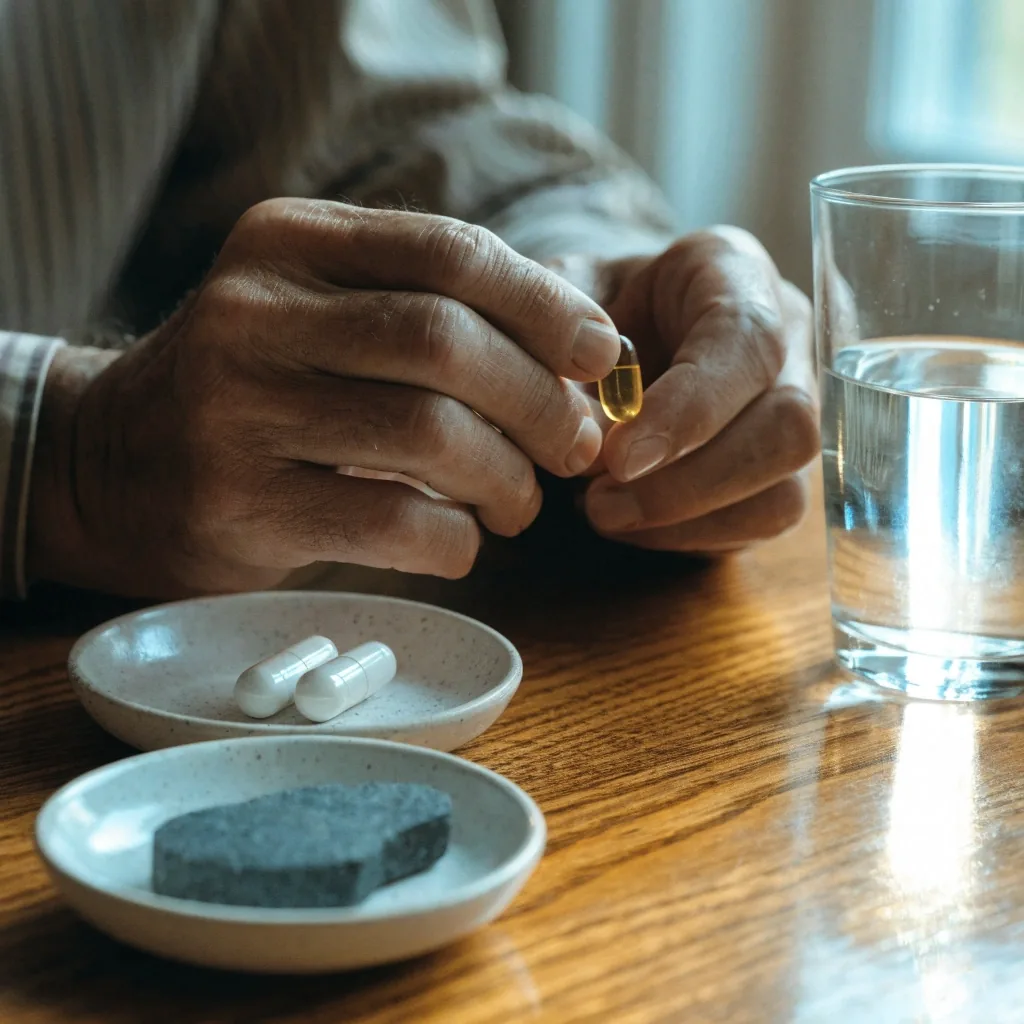
Capsules, a softgel and a dish of dried saw palmetto berries on a dark slate surface

The format tells you something too

A softgel, a pressed tablet and a two-piece capsule are not interchangeable. Oil-soluble entries such as vitamin E suit a softgel; mineral-heavy blends are usually pressed or encapsulated. When you compare two products with the same headline ingredients, the format and serving size often explain the price gap better than the ingredient names do.

Read the ingredient guide
A man in his fifties comparing two unlabeled supplement bottles in a bright kitchen

A practical route

The broad multivitamin usually comes first

For many men the practical first step is not a prostate-specific product at all. GNC Mega Men Sport is positioned as a multivitamin and mineral supplement for men with active lifestyles, sold through GNC Indonesia, and a broad blend like that covers baseline vitamin and mineral intake before you start stacking a second targeted product on top of it. Doing it in that order saves money and avoids double-dosing the minerals you already have.

Only once the base is settled does a targeted product make sense to consider — and then the question is narrower: which single nutrient or botanical is actually missing from what you already take, and is there a reason to add it at all. That question is easier to answer from the panel of your current multivitamin than from a shelf.

What supplement copy is not allowed to say

Indonesian regulations restrict what a supplement label may claim. On a compliant product you will not see treat, cure, or prevent, and that applies to this category as much as any other. Wording such as supports normal function is positioning, not evidence of an outcome, and the same phrase appears on dozens of unrelated products. Read it as a description of where the product sits, not as a promise about what will happen.

Anything touching a diagnosed condition belongs in a conversation with a doctor or pharmacist, not on a product page. A capsule is not a check-up, and a carefully worded label is not a second opinion. If a listing sounds more confident than Indonesian rules permit, that confidence is a reason to look harder at the product rather than a reason to trust it.

Before you buy anything

What to bring to a doctor's appointment instead

If you are noticing changes in urinary habits, sleep disruption, or anything your doctor has already flagged, that is a clinical question and a supplement page is the wrong place to answer it. What this page can do is help you prepare, so the appointment covers more ground than a single symptom.

Labels

Bring the actual panels

Take photos of every supplement you currently use, including the herbal ones. Doctors read ingredient lists faster than brand names, and a photo shows the extract strength, the serving size and the botanical entries that a product name hides.

Timing

Note when things happen

Changes that appear at night, after caffeine, or during long travel read differently to a clinician than a pattern that never varies. A short written record of when symptoms appear is more useful than a description assembled in the room.

Pharmacy

Ask about interactions

Indonesian pharmacy staff are used to these questions and can check a supplement list against any prescription you take. That check is quicker than searching for an answer, and it costs nothing to ask at the counter.

Where this category sits for Indonesian men

Prostate and age-related products are a small part of the men's supplement shelves here, and the range moves slowly compared with the stamina category. Anything genuinely targeted is often imported and priced accordingly, while local shelves lean toward general multivitamins with a mineral base. That is the honest starting point: if a prostate-positioned product is hard to find locally, the general multivitamin route is the more available option, and the ingredient guide covers both.

An older man and a pharmacist comparing two supplement bottles at a pharmacy counter

Questions readers send us about this category

Do prostate supplements replace a medical check?

No. Supplements are not treatments. If you have symptoms or a diagnosed condition, that is a clinical matter for a doctor in Indonesia. A capsule does not screen for anything, and no label can tell you what a check-up would.

Should older men take the same products as younger men?

Not automatically. Products aimed at younger men lean on stamina and vitality herbs, while prostate-positioned products focus on different nutrients, usually minerals and botanical extracts. Read the panel rather than the shelf section, and check what you already take before adding anything.

Why is the local range for this category so small?

Stamina and vitality products sell to a broader, younger audience, so shops stock more of them. Prostate-positioned products have a narrower buyer and often arrive as imports, which keeps the shelf shallow. You will find more choice in the general multivitamin section than in the prostate section of most Indonesian pharmacies.

How do I check for double-dosing minerals?

Write down the zinc and selenium amounts from every product you already use, then compare the total against the reference intake values printed on those panels. If a targeted product would push the totals well past the printed reference, that is the moment to ask a pharmacist rather than to add it into the routine.

Evening view over Jakarta from a high window, with a glass of water on the table in the foreground

Start with the ingredients, then decide what to add

The ingredient guide explains what each entry on a men's supplement panel actually is, and the comparison page lays general multivitamins side by side so you can see what a mineral base covers before you consider a targeted product. If you would rather ask a person, the contact page has our Jakarta details and working hours.

CorePoise · Jl. Jend. Sudirman Kav. 52-53, Senayan, Kebayoran Baru, Jakarta Selatan, 12190 · Monday to Friday, 09:00–18:00